A recipe for resilience: how one woman finds her voice

Even in the depths of despair, Kellie Price never gave up on her community.

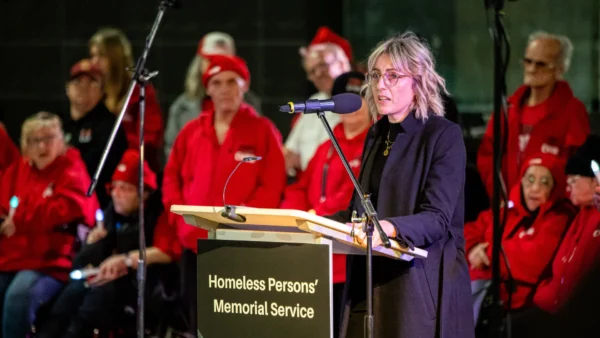
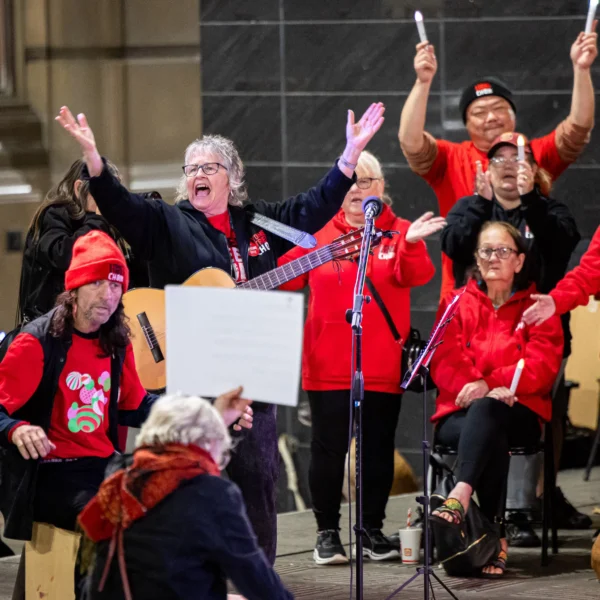
Despite losing her marriage, her job, and nearly her health, the Sydney woman stood proudly in her bright red Sydney Street Choir shirt, her hand wrapped in galvanised tie wire and gripping a self-bedazzled cane, as she reflected on the steps that brought her to the 2025 Sydney Street Feast.

“I thought it couldn’t get any worse. All I can do now is drop dead and then I’ll be happy,” Price recalled.

Broken from a divorce and jobless after suffering a work injury, the former chef relocated to the city to help support her aging parents before undergoing a spinal fusion procedure, and later falling victim to identity theft.

But despite the onslaught of life’s toughest battles, Price pushed on.

“I realised I’m not alone, and I want to feel like I’ve given back,” she said.

“It’s my sacrifice. It’s better than gold.”

Price, who used to work as a chef, began to rebuild by cooking in soup kitchens in Waterloo. But the injury to Price’s hand – the one wrapped in wire because she couldn’t afford to see a doctor – prevented her from keeping up with demand.

Without a clear direction on how to bridge her passion for food and desire to give back to the community, Price was at a standstill.

That is until she learned of the Sydney Street Choir.

It’s been one year since Price joined the music community, which supports people dealing with homelessness, mental illness, addiction, and other social disadvantages.

“The choir takes away all the shame,” she said.

“Everyone brings something different. It’s like a good recipe.”

Every Tuesday, she along with dozens of other members meet to rehearse for an impressive list of performances at community and corporate events, including the annual Sydney Street Feast.

This year’s event was full of joy and connection, Price said, and she was thankful to key sponsor PAYCE Foundation for making the environment feel so inclusive.

“I usually don’t get invited to things if I’m not cooking,” she joked.

“It’s a big thing, homelessness. Even identifying as being different is hard. But they make it so welcoming and they treat everyone with such care and dignity.”

Just before a fellow choir member waved Price over for another performance in front of the crowd, she talked hopefully about the future.

“My support worker and I are looking into teaching soup making,” she said.

“Everyone has their own journey and their own battles. And I always want to demonstrate love.”

PAYCE Foundation supports the launch of Mendable in the Southern Highlands

Through a direct donation and support delivered via the Southern Highlands Community Foundation Grants Program, the PAYCE Foundation was proud to help bring men’s group Mendable to life.

PAYCE Foundation director Dominic Sullivan (second from right) with SHCF director Annebel White (far right) with the Mendable team.

Mendable, an intergenerational men’s group designed to address social isolation and strengthen mental wellbeing among men aged 18 and over across the Southern Highlands.

Mendable welcomes men from all walks of life to come together in a safe, accepting and non-judgemental space. The group fosters emotional wellbeing, builds genuine connection and creates a supportive community where men can share experiences, express feelings and support one another through life’s ups and downs.

For many participants, Mendable offers a rare opportunity to break through social isolation, feel seen and heard and strengthen bonds with peers, support that is sadly not easy for all men to find.

Why a group like Mendable matters

The need for initiatives like Mendable is clear.

According to the Australian Institute of Health and Welfare, around 17 per cent of Australian men aged 15 and over reported experiencing social isolation in 2023, compared with 13 per cent of women.

Research from the Australian Institute of Family Studies shows that up to 25 per cent of Australian men will experience a diagnosable mental health disorder during their lifetime, with around 15 per cent affected in any given 12 month period.

AIFS research also highlights a strong link between loneliness and an increased risk of depression and suicidal thoughts or behaviours among men.

Data on social connectedness shows that around 4 per cent of adult men report having no close friends or relatives, while approximately a quarter report low levels of perceived social support or meaningful relationships.

Given these realities, community-based men’s groups like Mendable play a vital role. They provide a place where men can connect, feel supported, share openly and reduce the risk of drifting into isolation or despair.

Bob Tangey from Mendable said the idea grew from seeing a gap in support for men beyond their teenage years.

“After spending many years working in youth engagement, it became increasingly apparent there is a growing need to support men after the age of 18 to avoid them slipping through the cracks and struggling alone with social isolation and mental health

“Through Mendable, our goal is to invite people to belong, no matter who they are or what their struggles may be. We help them settle in and feel part of something bigger. It is the group members that make the group what it is. Each person brings their own life experience, personality and knowledge, which means the group learns and grows together.”

There is strong evidence that peer support groups like Mendable can provide regular, low cost and accessible assistance, particularly for men who may be less likely to seek formal mental health services. Just as importantly, they offer a trusted environment where members can ask for help, whether that is through a referral to professional support or simply a friendly ear.

“Mendable is a low pressure, casual environment,” Bob said. “There are no expectations. We are just a group of men getting together and enjoying good company, with self-directed activities along the way. It is a simple idea that can have incredibly positive and long-lasting outcomes.”

Mendable and projects like it have the power to build healthier lives and break harmful cycles for future generations. As the Mendable team says, prioritising mental health is not a weakness. It is a strength that helps men communicate better, connect with others and live longer, healthier lives.

Mendable has now been running for nine weeks and meets once a week on Fridays in Bowral for two hours. Sessions may involve working on small projects, sharing skills, visiting a local venue or simply having a coffee and a catch up. The group is led by its members and shaped by their interests and needs.

The battle to end street sleeping gathers momentum in 2026

Last year marked a defining chapter in New South Wales’ efforts to end street sleeping, with major system reform, measurable outcomes and growing momentum across the sector, according to the End Street Sleeping Collaboration (ESSC).

Despite significant challenges, the year delivered substantial progress, particularly through the continued development and implementation of the By Name List.

For the first time in NSW, homelessness could be measured and tracked in real time, allowing services to understand how long people experience homelessness and whether it is rare, brief and non-repeated.

This work directly influenced the NSW Government’s new ten-year Homelessness Strategy, which places a person-centred approach at the heart of policy and commits to strengthening local collaboration networks and introducing a statewide street sleeping registry.

The By Name List has now been licensed nationally through the Australian Alliance to End Homelessness and adopted in Western Australia, South Australia and regional Victoria.

In NSW, collaboration networks including Sydney Zero and Northern Rivers Zero continue to grow, with more than 270 registered users across 24 organisations in Inner Sydney alone.

High levels of engagement have driven targeted action, including improved temporary accommodation practices, stronger evidence on women experiencing primary homelessness and increased support for tenancy sustainment.

Other key initiatives included a NSW Health pilot granting health professionals access to the By Name List, the Early Engagement Module, a performance management tracker and a focused project supporting women rough sleeping around Central Station.

Dominic Sullivan, co-chair of the End Street Sleeping Collaboration and a Director of the PAYCE Foundation, said the progress reflects years of collaboration and sustained commitment.

“As the founding philanthropic partner of the End Street Sleeping Collaboration, the PAYCE Foundation has seen firsthand what is possible when government, community organisations and philanthropy align around shared outcomes,” Sullivan said.

“The By Name List has fundamentally changed how homelessness is understood and addressed in NSW, and its impact will continue to be felt for years to come.”

While short term funding agreements are welcome, in 2026 we will continue to advocate for a long-term government commitment to ensure this vital work remains sustainable and that less people find themselves living on the streets.

Promising pathways to recovery and employment at Adele House

Now operated by the St Vincent de Paul Society NSW, the residential drug and alcohol program near Coffs Harbour is backed by the financial support of the PAYCE Foundation and the NSW Drug Court referral program.

Adele House is a purpose built, $10 million facility jointly funded by the PAYCE Foundation and the NSW Government. It has helped hundreds of men rebuild their lives and reintegrate into the community.

In 2025, Adele House supported 65 men through alcohol and other drug rehabilitation, including 31 men who identify as First Nations.

Referral and care pathways have been established with Drug Courts across NSW and the Metropolitan Referral and Remand Centre, alongside the engagement of an Addiction Specialist to support treatment continuity following release from custody.

A major focus has been the development of a Work Skills Program, introduced in March 2025 and covering hospitality, horticulture, ground maintenance and job readiness.

Director of health services for St Vincent de Paul Society NSW, Monica Yanni, said that of the 65 men supported, 44 have participated in the program, representing 67 per cent of all residents.

“Our Work Skills Program has become a cornerstone of recovery at Adele House, supporting confidence, purpose and pathways to employment,” Yanni said.

“We are also proud of the way our clients are encouraged to give back, whether through preparing meals for people experiencing homelessness at Pete’s Place or contributing to our thriving organic gardens that now support daily meal preparation.”

PAYCE Foundation director Dominic Sullivan said ensuring men have the skills to return to the community addiction free, with strong prospects of holding down a job, is critical to preventing relapse.

A Boost for the Next Generation: PAYCE Foundation supports mentorship program growth

A youth mentorship program is delivering exceptional support in the Southern Highlands of NSW, thanks in part to a $20,000 donation from the PAYCE Foundation.

Raise Youth Mentoring Program, supported locally by the Southern Highlands Community Foundation (SHCF), is a national not-for-profit providing early-intervention, school-based mentoring to young people facing rising pressures such as loneliness, financial hardship, and mental health.

Research shows that a caring, non-parental Mentor helps teens build resilience, belonging, and hope for the future.

SHCF Chair Jennifer Bott AO said the partnership with PAYCE Foundation has been vital in both raising awareness and driving “real and lasting change”.

“Together we’ve provided confidence, hope, and mentors to those who need them most, creating a powerful community of support,” she said.

“It means the world to us, and it makes the world of difference.”

In 2025, Raise successfully delivered 189 programs to 173 schools across the country, supporting 2,753 mentees, while also launching Raise Digital – a national online mentoring platform.

Bott said Raise mentoring achieved “statistically significant impact” for young people in all four key outcome areas: help seeking, resilience, school engagement and hope for the future.

“Everything we do is about improving outcomes for young people,” she said.

“And this year has continued to show consistent impact in the lives of the young people in our programs.”

Raise mentors are matched with students who have weekly one-on-one sessions for 23 weeks, concluding with a graduation celebration.

The program’s curriculum is designed to strengthen the mentor-student relationship while building key skills in mental health support, social and emotional wellbeing, and school engagement.

Curriculum topics align with the Australian Student Wellbeing Framework and cover areas such as identity, help-seeking, goal setting, resilience, future planning, community connection, and job-seeking.

“Looking ahead, we’re thrilled to embark on new initiatives together, further empowering and uplifting the next generation,” Bott said.

PAYCE Foundation Director Dominic Sullivan said supporting young people helps strengthen local communities.

“Youth wellbeing ensures young people can participate fully in their communities and are more likely to transition successfully into adulthood,” he said.

“We want to ensure younger generations have the opportunity to make real, positive change, which has a ripple effect into future years.”

Sullivan said the PAYCE Foundation, which is a major supporter of the Southern Highlands Community Foundation, looks forward to seeing Raise continue its impact on young Australians.

“We’re happy to be a part of the important work Raise and the Southern Highlands Community Foundation are doing,” he said.

From many roles to one farewell: Leonie Oakes takes a bow

No job description has ever been broad enough for Leonie Oakes.

She’s a case worker, a psychologist, and a group driver for the Sydney Street Choir.

“When I joined six and a half years ago, it was a very different choir,” the Social Welfare Worker said.

“My role has grown so much because I’ve just kind of tried to respond to what the choir wants.”

But this week, Oakes steps down from her position, becoming one more member of the singing community she helped shape.

The Scientific Officer at the University of New South Wales began her role with the choir in 2018 while searching for full-time work.

It would only be for six months, she thought.

“I just couldn’t leave,” Oakes said, laughing.

“It just sort of draws you in.”

She remained fluid over the years, happily morphing into any role her choir members needed, Oakes explained.

“Sometimes I’m walking into housing with people. Sometimes I’m going to a doctor’s appointment, or going to the courts,” she said.

“I just learned so much.”

And much like her role itself, the Sydney Street Choir also took on many forms.

“It was always changing all the time because the choir had different issues,” Oakes said.

“Originally, we just met and we sang. But they kept on saying, ‘Oh, can we kind of chat? Can we do more things?’

“So, over the years, we’ve tried to make the choir a much more, bigger family and they’ve responded very well to that.”

Oakes had many achievements in her time with the choir. One of her favourites was bringing in more women, which is now split evenly, 50-50, she said.

But her proudest was surviving COVID.

“Choir on Zoom is the worst thing,” Oakes said, jokingly.

“When vaccines became available, our choir instantly went. They knew about vaccines and they all went and got vaccinated really quickly.”

While the choir grew and changed throughout the years, Oakes said it always held one definitive characteristic: community.

“It’s sort of taken on a life of its own. The choir has really grown and supported each other.”

Oakes recalled a moment which reflects just this.

It was two years ago, she said, when one choir member became ill and had little time left to live.

“It was Christmas, and my phone was off. So, the choir decided they would be there to support her in her final moments.

“Everybody in the choir pulled together and made sure she had food, visited her once… twice… three times a day, called doctors, called ambulance, contacted her family.

“By the time I came back to work, she had passed.”

It was a sad experience, but a meaningful one to Oakes. It showed the strength of community among members, whether she was there or not.

“They had supported her,” Oakes said.

“The choir was there.”

Though members had created a community amongst themselves, Oakes thanked the PAYCE Foundation for making it all possible.

“PAYCE was always so open to things we were doing,” she said.

“The choir has evolved and changed, and they’ve been lovely about that. They’d tell me to keep going –­ the big picture is about community and involving people.”

While Oakes departs from her position with the choir this year, she said she will return to take part in some rehearsals.

“I can’t leave them. They are such extraordinary people that come from so many different backgrounds and they’re so supportive of each other,” she said.

“It’s really lovely being with them.”

The role was funded by the Sydney Street Choir Corporate Challenge – the brainchild of the PAYCE Foundation.

Christmas time to remember those less fortunate

Christmas is often described as a season of joy, but for many people it can be the saddest and loneliest time of the year.

In New South Wales, thousands of people will be homeless on Christmas day, and countless others face isolation, hunger and financial hardship.

This sadly includes increasing numbers of young people, women and those that have never needed assistance before.

At the PAYCE Foundation, we believe no one should feel forgotten at Christmas.

That is why we proudly partner with charities making a real difference on the frontline Vinnies, End Street Sleeping Collaboration, Sydney Street Choir, Thread Together and St Merkorious Charity.

These organisations provide food, clothing, support, connection and dignity to people who need it most.

Their work reminds us what the season is truly about: compassion and community.

If you are able, we encourage you to help these remarkable charities anyway you can so they can continue their vital work.

Sydney Street Choir enjoy Christmas lunch with PAYCE Foundation

The Sydney Street Choir gathered this week for a Christmas lunch prepared and served up by the PAYCE Foundation and St. Merkorious Charity.

The groups met at Redfern Oval on Tuesday afternoon as part of an annual tradition of celebration, PAYCE Foundation Director Dominic Sullivan said.

“They bring so much joy to this city. They’re a real community who take care of each other,” he said.

“And so for us, it was an opportunity with St. Merkorious to provide a Christmas lunch for them.”

The Sydney Street Choir is a supportive musical community for people experiencing homelessness, mental illness, or other social disadvantage. The Choir is the nation’s longest running street choir.

Founded in 2001, the choir uses music to empower members, build community and provide support, with members meeting weekly for rehearsals and performances.

Mr Sullivan said the group has grown from strength to strength over the years.

“There were over 50 people here today,” he said.

“This is a real opportunity to show our support for the choir.”

The Redfern Oval echoed this week with songs ranging from classic 80’s music to cheery Christmas carols.

Following rehearsals, the choir enjoyed a hot meal complete with Christmas poppers and paper hats.

PAYCE Foundation Tony Wishart said it was a great opportunity to spend time with the choir.

“It’s really good for our team to see the choir really enjoying themselves,” he said.

“PAYCE Foundation has been supporting them for many years, but to actually see the impact, it’s important.”

Wishart said the Foundation team members also enjoyed seeing the growth of the choir, which includes the addition of a new musical director who brings “great energy” to rehearsals, together with a new social worker.

“It’s wonderful to see how the Choir has grown and strengthened over the years. It feels like it’s constantly improving,” he said.

“The word is getting out there even more. They’re just a great unit and such a supportive community.”

PAYCE Foundation funds new mobile wardrobe

The PAYCE Foundation has announced a three-year sponsorship to support Thread Together’s life-changing work delivering clothing and dignity to people in need across NSW.

PAYCE Foundation Director Dominic Sullivan, PAYCE Foundation Director Sophie Boyd and Thread Together CEO Anthony Chesler.

The $190,000 commitment will fund the lease of a new mobile wardrobe, ensuring thousands of vulnerable individuals continue to access brand-new clothing during times of hardship.

The purpose-built van will visit crisis accommodation services, women’s refuges, recovery centres, community hubs and regional communities, providing dignified, choice-based clothing support for people experiencing homelessness, escaping domestic and family violence, seeking asylum, or recovering from natural disasters.

PAYCE Foundation Director Dominic Sullivan said the partnership aligned with the Foundation’s mission to support practical, impactful community solutions.

“Thread Together’s work is simple and powerful – providing brand-new clothing to people doing it tough and restoring dignity at a time they need it most,” Mr Sullivan said.

“We are proud to continue our support for such an innovative program that brings help directly to communities. This investment ensures essential services can reach more people, more often, right across NSW.”

Thread Together CEO Anthony Chesler welcomed the renewed partnership, saying the support will have a direct and meaningful impact on communities facing hardship.

“We are incredibly grateful for the PAYCE Foundation’s ongoing commitment,” Mr Chesler said.

“The mobile wardrobe is one of the most effective ways we deliver clothing to people in crisis. This funding ensures we can keep getting quality clothing into the hands of people who need it most – with dignity, choice and compassion.”

Since launching in 2012, Thread Together has rescued millions of new fashion items from landfill and redistributed them to people in need through partner charities and mobile wardrobes.

The PAYCE Foundation has been a long-standing supporter of Thread Together, previously supporting a program to assist women in children who had been victims of domestic violence.

PAYCE Foundation welcomes new plan for addiction treatment

The PAYCE Foundation has welcomed the NSW Government’s response to the Drug Summit, especially its strong commitment to early intervention, prevention and diversionary programs that steer people away from the criminal justice system and towards treatment and rehabilitation.

PAYCE Foundation Directors Dominic Sullivan, Tony Wishart, and Talal Ghattas alongside NSW Deputy Premier Carmel Tebbutt.

The Foundation also congratulated former NSW Deputy Premier Carmel Tebbutt, co-author of the original NSW Drug Summit alongside John Brogden, for her longstanding leadership in evidence-based drug policy reform.

PAYCE Foundation Director Dominic Sullivan said the Government’s renewed focus on health-based responses would help reduce harm, strengthen families and ensure more people receive the support they need, when they need it.

“Prevention and diversion are proven pathways to breaking cycles of addiction and disadvantage,” Mr Sullivan said.

“We commend the Government for taking these steps, and acknowledge Carmel Tebbutt and John Brogden for their enduring, bipartisan work in guiding NSW to a more compassionate and effective drug policy framework.”

The PAYCE Foundation has long invested in practical solutions that change lives, including the construction and co-funding of Adele House, one of NSW’s most respected rehabilitation facilities, which is managed by the St Vincent de Paul Society NSW. Built in partnership with the NSW Government, Adele House has set a benchmark for high-quality, residential drug and alcohol treatment for men.

Alongside this investment, the Foundation is also a strong supporter of Odyssey House. A recent PAYCE Foundation philanthropic contribution is helping Odyssey House, led by CEO Carmel Tebbutt expand its capacity to support individuals and families on their recovery journey.

“These services save lives,” Mr Sullivan said. “Our commitment is to continue partnering with organisations that deliver real, lasting change and give people a second chance.”

“We look forward to continuing our support for Carmel and the team at Odyssey House.”